Some links in this post are affiliate links. As an Amazon Associate I earn from qualifying purchases.
Three 12-hour shifts sounds like a great deal on paper: four days off every week. In practice, a lot of healthcare workers find that the shift days swallow everything, the first day off is spent recovering, and the rest disappear into errands and family. Exercise is the first thing to slide.
This guide is a realistic way to stay active through a three-12s week. It does not ask you to run before a 7 a.m. shift or lift weights at 9 p.m. when you can barely stand. Instead, it treats the week as two different kinds of days, shift days and off days, and gives each a different job. It’s general information for healthy adults. If you have a health condition or injury, check with your own clinician about what kind and amount of activity is right for you.
The goal for the week
The CDC’s guidance on adding physical activity as an adult says adults need 150 minutes of moderate-intensity activity a week plus two days of muscle-strengthening activity, and that the 150 minutes can be broken up. The CDC also says some physical activity is better than none.
That second point matters for shift workers. You do not need to hit an ideal number every week to make progress. A rough target for a three-12s week might be:
- Two short strength sessions on days off.
- Walking or other moderate activity spread across the week, including your shifts.
- Mobility or stretching after shifts, when you can.
On shift days: protect energy, move in small pieces
On a 12-hour shift day, your main jobs are to do your work well, eat, drink water, and sleep. A separate workout is optional. Many people on their feet for 12 hours already rack up a lot of walking. You don’t need to add a run on top of that.
What does help on shift days:
Short movement breaks
If your shift is mostly charting, sitting at a monitor, or standing in one spot, a few minutes of movement can break up long stretches. Our 5-minute nurses’ station routine is designed for this: gentle movements you can do in scrubs without equipment.
A stretch when you get home
After the shift, a short, easy stretch sequence can be a nice signal that work is done. Our stretch sequence after a 12-hour shift takes about ten minutes. Keep it gentle; this is not the time to push for flexibility.
Sleep comes first
The Sleep Foundation’s article on shift work disorder explains how working against your body clock can disrupt sleep. NIOSH’s training for nurses on shift work and long hours covers similar ground. On a stretch of shifts, a workout that cuts into sleep is usually a bad trade. If you have to choose, choose sleep.
On days off: the real training days
Your days off are where most of your planned activity can happen. But not every day off is the same.
Day off 1: recovery day
The first day after a run of shifts, especially nights, is often a day to catch up on sleep and reset. That doesn’t mean doing nothing. Light movement, like a walk outside, an easy bike ride, or some stretching, can fit nicely into a recovery day without draining you. Our active recovery day template is a good fit here.
Days off 2 and 3: strength days
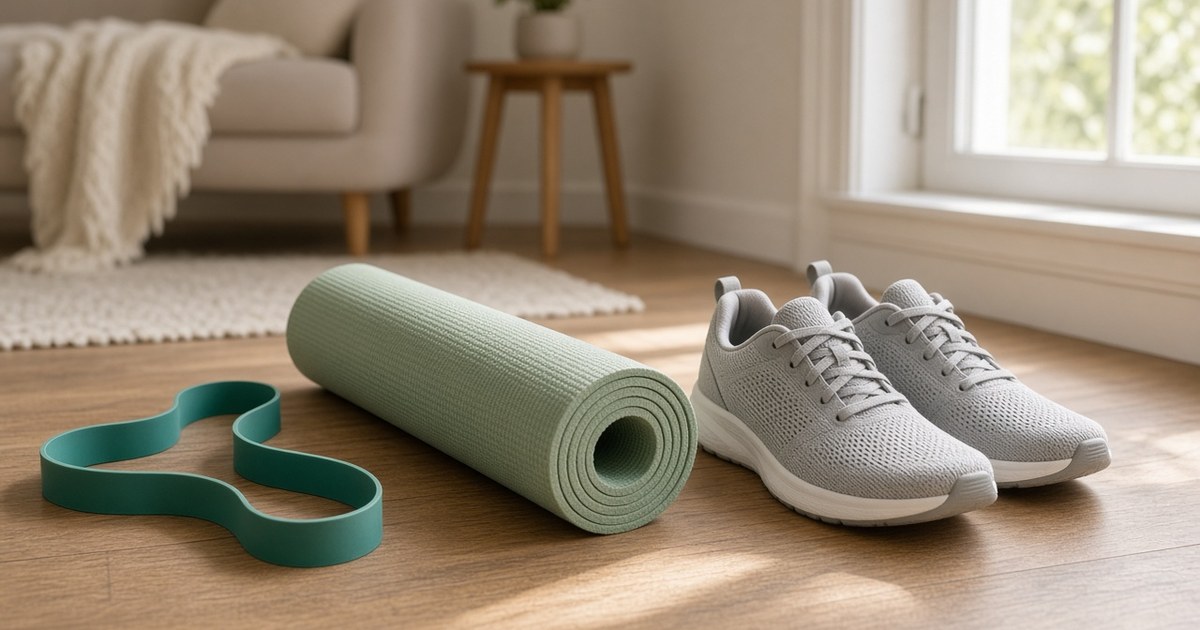
These are your best opportunities for strength training. Two sessions of 20 to 30 minutes each is enough to work toward the CDC’s two-days-a-week guideline. You don’t need a gym. A set of loop resistance bands and your body weight cover a lot of ground.
A simple full-body session might look like this. Do 2 to 3 rounds, resting as needed:
- Squats or sit-to-stands from a chair, 10 to 12 reps.
- Glute bridges with a loop band above the knees, 10 to 12 reps.
- Band rows (anchor a long band or loop it around a sturdy post), 10 to 12 reps.
- Incline push-ups against a counter or bench, 8 to 12 reps.
- Side-lying or standing band leg raises, 10 per side.
- A plank on your forearms or hands, 20 to 30 seconds.
A basic set of loop bands like Fit Simplify resistance loop exercise bands comes in several resistance levels, so you can go lighter or heavier for different moves. They store in a drawer or a work bag. Our resistance band circuit offers more ideas.
Start with lighter resistance than you think you need, keep your movements slow and controlled, and stop any exercise that causes pain.
Day off 4: flexible day
Use this one for whatever you enjoy: a longer walk, a hike, a class, a swim, playing with your kids. It’s also a good buffer if a strength session got skipped. Just avoid stacking a hard workout on the evening before your next 12, when you’d rather be resting.
A sample week
Here’s one way a three-12s week could look if you work Monday, Tuesday, and Wednesday day shifts:
- Monday (shift): Movement breaks at work. Short stretch at home.
- Tuesday (shift): Movement breaks. Bed on time.
- Wednesday (shift): Movement breaks. Bed on time.
- Thursday (off): Sleep in if you need to. 20 to 30 minute walk.
- Friday (off): Strength session, 25 minutes. Walk if you feel like it.
- Saturday (off): Longer walk, bike ride, or another favorite activity, 30 to 45 minutes.
- Sunday (off): Strength session, 25 minutes. Early night before Monday’s shift.
If your shifts are split up, like Monday, Thursday, and Saturday, the same idea works. Place strength days on days off that aren’t immediately after a night shift, and keep the day before a shift lighter.
For night-shift workers, shift the whole plan so that your first day off is a true recovery day and strength sessions happen after you’ve had a full sleep.
When the week goes sideways
Healthcare schedules are unpredictable. You get called in, you pick up an extra shift, or your kid gets sick. A few ways to keep a disrupted week from becoming a lost month:
- Shrink the workout rather than skip it. One round of the strength circuit instead of three still counts.
- Make walking the default. On days when you have nothing left, a 10-minute walk keeps the habit alive.
- Don’t try to make it up. Doubling up workouts to “catch up” often leads to soreness and burnout. Just pick the plan back up next week.
- Notice patterns. If every week you skip the same session, move it to a different day.
Make it easier to start
Most of the hard part is starting. Some small things that help:
- Lay out workout clothes the night before a planned strength day.
- Keep your bands somewhere visible.
- Pair your workout with something you already do on days off, like after your morning coffee or before you shower.
- Find a coworker with a similar schedule and plan days-off walks together.
The bottom line
Three 12-hour shifts a week doesn’t have to mean three days off from activity and four days of recovery. Let shift days be about small movement and sleep, let your first day off be gentle, and use the remaining days for two short strength sessions and some activity you enjoy. Over time, that adds up.
Related reading
- How to make a 12-hour shift go by faster
- Stretch sequence after a 12-hour shift
- Active recovery day template
- 5-minute nurses’ station routine
Not medical advice. Content here is general information and not a substitute for advice from your own clinician.