Not medical advice. This is general fitness information for healthy adults. It is not a treatment plan, a weight-loss program or a substitute for advice from your own clinician. If you have an injury, a medical restriction or you feel unwell, follow your clinician’s guidance.
If you work in healthcare, a holiday off is not guaranteed. When you do get Thanksgiving, Christmas or another holiday away from work, it can be tempting to treat the day as a chance to “make up” every missed workout. That usually backfires. A useful plan is smaller: add a little movement you can actually do around family, travel or rest, and leave the rest of the day alone.
If you are working the holiday instead, this article is not for that situation. See our earlier guide, Working Holiday Shifts: How to Eat and Move When You Work Thanksgiving or Christmas.
The diagrams in this article are original flat illustrations created for Healthcare Worker Fitness. They are not photographs of a real person or a real gathering.
A short walk is enough of a plan
The CDC’s physical activity guidelines for adults recommend at least 150 minutes a week of moderate-intensity aerobic activity, such as brisk walking, or 75 minutes of vigorous activity, or an equivalent mix, plus muscle-strengthening activity on at least two days. Those minutes do not have to happen in one session. The CDC notes that you can spread activity through the week and break it into smaller chunks, and that some physical activity is better than none.
A holiday off does not have to carry the whole week’s total by itself. If you walk for 10 or 20 minutes after a meal, that time still counts toward the weekly recommendation. You do not need a gym, a timed workout or a plan to “earn” the meal.
Ideas that fit a family day
The CDC’s page How to Have Healthier Holidays in 1-2-3 lists practical ways to stay active during the holidays. The examples below follow that list. Pick one that fits the day you actually have, not an ideal day.
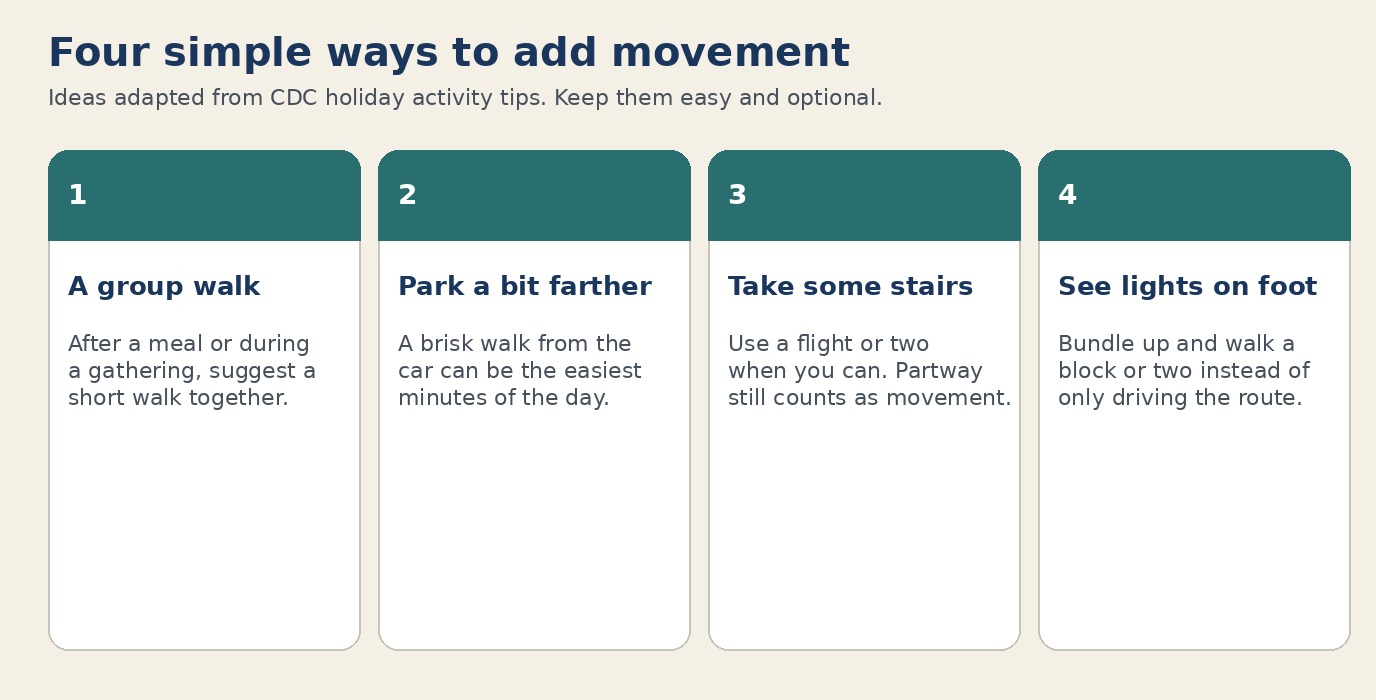
- Walk with other people. When friends or family gather, the CDC suggests a group walk. A loop around the block or a short path after the meal is enough. If no one wants to join you, a solo walk is still a complete plan.
- Park a little farther away. Rather than hunting for the closest space, the CDC suggests parking farther away and walking briskly to the door. That works at a relative’s house, a store or a gathering, when weather and safety allow.
- Use the stairs when you can. The CDC suggests taking stairs at every opportunity, and taking them part of the way if you cannot do the whole flight.
- Look at lights on foot. Instead of only driving a holiday-light route, the CDC suggests bundling up and walking. In Western Pennsylvania in late November, keep the walk short, wear visible layers after dark and choose a familiar, well-lit street.
- Make shopping include a lap. If you are already at a shopping center, the CDC suggests walking a few laps before going into stores.
None of these is a required circuit. If the day is for sleep, travel or sitting with someone you rarely see, a 10-minute walk still counts, and so does skipping the walk when you need rest.
Keep it easier than a make-up session
A day off after a stretch of long shifts is a poor time to jump into the hardest workout on your list, especially if you have been sitting in a car or have not exercised in a while. If you do want a longer session, start easier than usual and use a brief warm-up. Our recent article, From the Car to Your Workout: A Warm-Up Plan for Healthcare Workers, covers that transition.
Kitchen work, a scavenger-hunt walk with kids, or an easy game in the yard can count as movement too. The CDC holiday page also mentions active group games and turning a walk into a scavenger hunt. Treat those as optional add-ons, not a scoreboard.
If you are traveling
A long drive or a delayed flight can leave you stiff and short on time. Build in a few minutes of walking at a rest stop or in an airport corridor when you can do so safely. You do not need a full workout in a hotel hallway. The same CDC idea applies: a few minutes of moderate activity can count toward the weekly total.
Pack shoes you can walk in, a layer for cold weather and whatever you already use to be visible after dark. Leave new equipment and ambitious training plans at home.
What this plan is not
It is not a reason to skip rest, skip a meal or start a new high-intensity program because you finally have a day off. It is also not a rule that every holiday must include a walk. Ice, darkness, a crowded kitchen or a long drive can be good reasons to stay inside and try again later.
If you already have a routine you like—an easy bike ride, a familiar strength session, a walk with a dog—use that routine at a comfortable pace. The CDC holiday tips are extras for a day that does not have a usual slot, not a replacement for a plan that already works.
A one-line plan you can keep
Write one cue for the day, such as “Walk 15 minutes after the meal” or “Take a short walk before we sit down.” That is the whole plan. If the cue does not happen, you have not failed the holiday. You can walk the next day you are off, or simply return to the routine you already use on workdays.
This is general information, not a promise about weight, mood or injury. Follow any limits from your own clinician, and skip outdoor walking when ice, traffic or weather makes it a poor idea.
Not medical advice. Content here is general information and not a substitute for advice from your own clinician.