Not medical advice. This is general fitness information for healthy adults. It is not rehabilitation, a readiness test for patient handling or a guarantee against injury. Follow any exercise restrictions from your own clinician.
The diagrams in this article are original flat illustrations created for Healthcare Worker Fitness. They are not photographs of a real person, a real commute or a real workout.
A day off can bring a surprisingly abrupt transition: sitting in the car, answering messages, then trying to start a workout at full speed because the free hour is disappearing. Healthcare workers already make plenty of fast transitions at work. Exercise does not need to begin with another one.
A warm-up is the quieter beginning of the activity you have chosen. It gives you room to move gradually, check your surroundings and settle into an appropriate starting pace. It is not another demanding circuit to complete before the “real” workout, and you do not need a watch, foam roller or special routine to do it.
Warm up for the workout, not for your job title
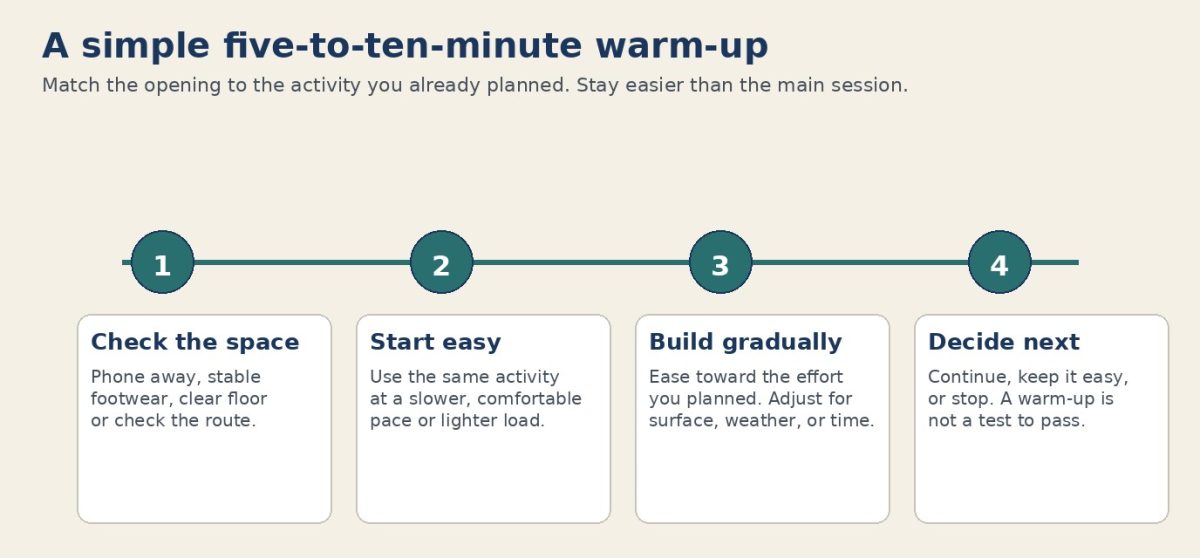
The American Heart Association recommends warming up for five to ten minutes, using the activity you plan to do at a slower pace. It notes that more intense activity calls for a longer warm-up. That is a useful starting principle for a walk, a ride or another familiar aerobic activity.
Being active during a hospital shift is not the same as preparing for the specific exercise you are about to do. Nor does a warm-up certify that someone is fit to lift or reposition a patient. Workplace handling procedures, appropriate equipment, training and assistance remain separate matters.
Start by naming today’s session: “an easy walk,” “a familiar bike ride” or “my usual strength exercises.” A specific answer helps you choose a relevant beginning. If you cannot name the activity because you are still deciding between several hard workouts, choose the session before trying to warm up for all of them.
Make the transition before you start the timer
After parking, take a moment to put away your phone and check the space. Choose stable footwear appropriate to the activity. For indoor movement, clear cords, bags and anything that could roll underfoot. For outdoor movement, consider the surface and visibility before heading away from home.
This is preparation, not a prescribed exercise dose. It is also a chance to notice whether you are simply reluctant to begin or actually feel unwell. Do not use a warm-up to argue yourself past new symptoms, an injury or a medical restriction. If you feel unwell, stop and seek appropriate guidance rather than treating completion of the routine as permission to continue.
When time is tight, make the main session simpler instead of making the opening frantic. You can choose an easier activity or a shorter route without turning the first minute into a sprint.
Example one: ease into a days-off walk
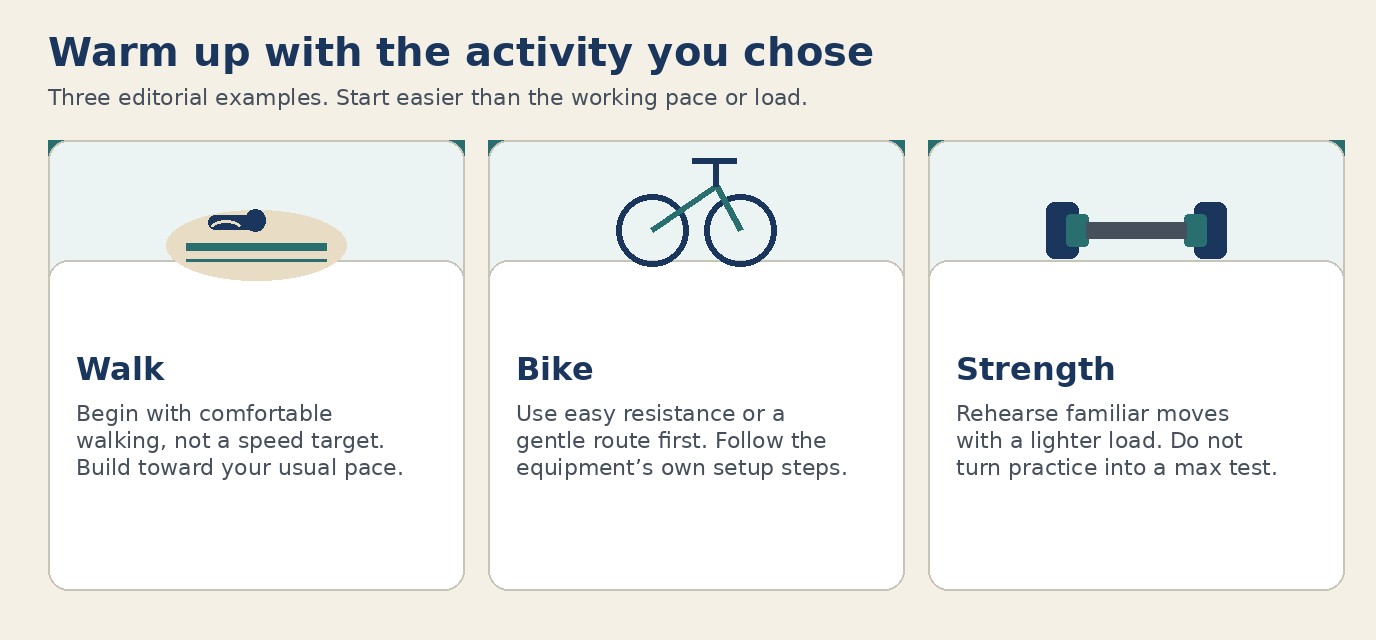
Begin with comfortable walking rather than immediately chasing a speed target. Let your arms move naturally and choose a route that allows you to slow down or turn back. Gradually work toward the pace you intended for the main walk over the warm-up period.
There is no need to reach a particular distance during those first minutes. An incline, an icy patch or a crowded sidewalk can change the effort even when your pace seems slow. Adjust to the actual route rather than following a pace copied from a previous outing.
The CDC describes the talk test as a rough way to judge aerobic intensity: at moderate effort, a person can talk but not sing. That describes the main activity’s effort, not a target you must reach immediately. This warm-up can stay easier while you settle in. No heart-rate formula is required for the example.
Example two: begin a familiar bike session gently
For a stationary bike you already know how to use, begin with an easy resistance and comfortable pedaling. Build gradually toward the effort planned for the session rather than opening at yesterday’s working resistance. Follow the equipment instructions and make any necessary fit adjustments before pedaling.
For an outdoor ride, choose a gentle beginning where conditions permit. Traffic, a steep driveway or a busy intersection may make your front door a poor starting point for a relaxed opening. Plan around those constraints rather than insisting that every ride must begin in exactly the same way.
The shared principle is gradual progression within the chosen activity. This is not a recommendation to buy a bike or to choose cycling over walking; use an activity that fits your experience and circumstances.
Example three: prepare for familiar strength movements
A strength session needs preparation relevant to its movements, not just a hurried stretch. Follow the warm-up instructions in the program you already use. If you work with a qualified exercise professional, ask how to scale those instructions when you have been sitting or when the planned session changes.
For familiar exercises, a practical approach is to rehearse the movement with an easier variation or lighter resistance before the working sets. Treat that as practice, not an extra challenge. Keep the movement controlled and do not turn preparation into a test of maximum repetitions.
This is an editorial example, not an AHA-prescribed lifting protocol or a new rehabilitation routine. If the exercise is unfamiliar, the answer is instruction—not more weight, more stretching or a longer warm-up. Do not improvise a new lift simply because the initial movements felt comfortable.
Decide what comes next without making promises
After the easy opening, ask whether you can perform the planned activity comfortably and with control. You might continue, keep the whole session easy or stop. A warm-up is not a diagnostic test, and feeling warmer does not guarantee that the workout is appropriate.
Avoid treating soreness, exhaustion or pain as obstacles that must be defeated before you are allowed to change the plan. Repeated problems during exercise deserve individual assessment. General internet instructions cannot tell you whether a symptom is harmless.
When the session ends, leave room to slow down. The AHA also recommends a gradual cool-down rather than abruptly stopping aerobic activity. That is a separate closing step, not a reason to make the warm-up harder.
Make the first minutes repeatable
Write one simple cue beside your next planned workout: “Begin with an easier version of this activity.” That cue is enough. You do not need to record a perfect warm-up streak or add a shopping list.
The point is a less abrupt beginning, matched to the session in front of you. It is not another measure of whether you have been productive enough on a day away from work.
Not medical advice. Content here is general information and not a substitute for advice from your own clinician.